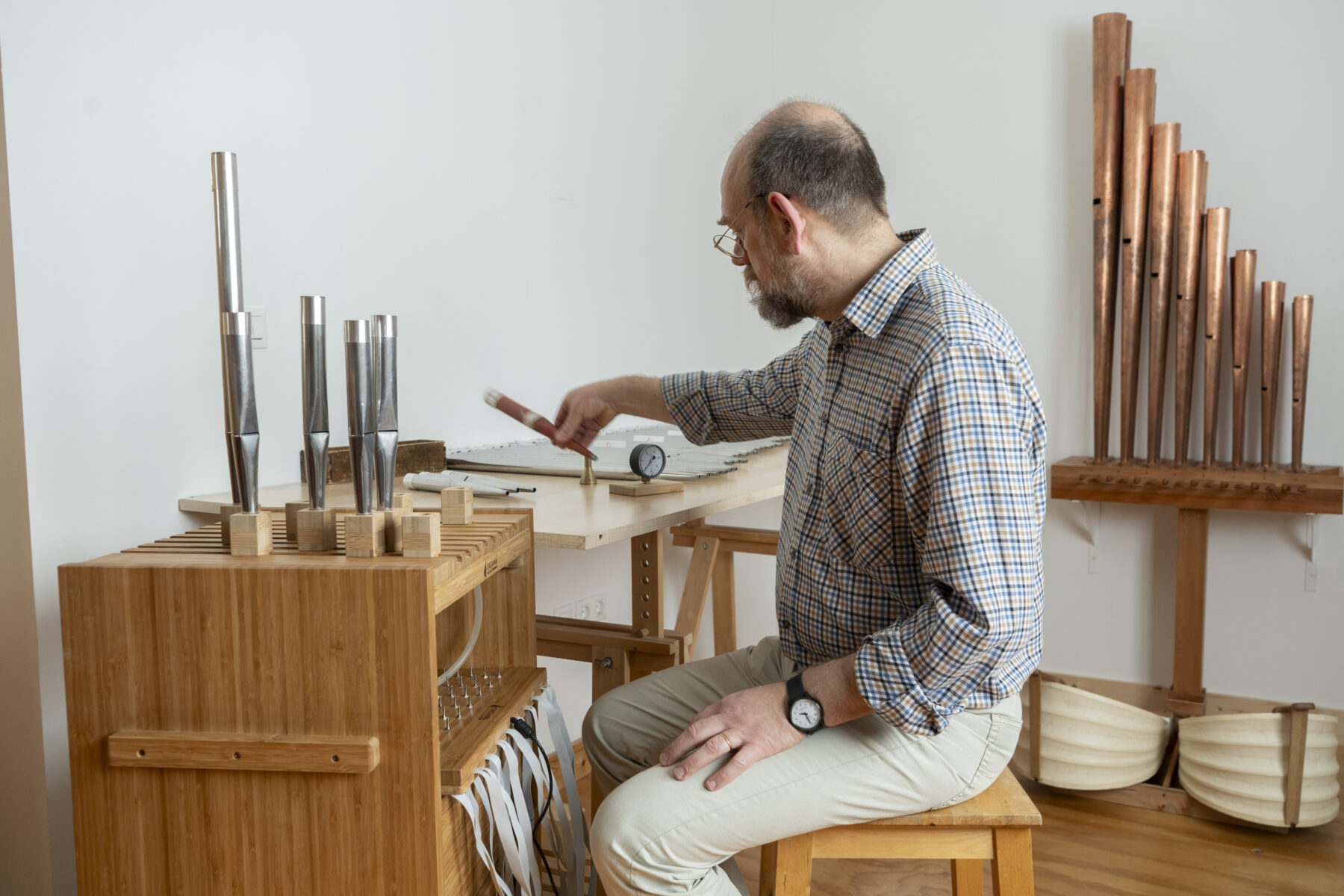
Development of a variable-geometry experimental setup for the study of organ pipe ensembles.
Auditorium della Civica Scuola di Musica Claudio Abbado, Milano
Free participation by invitation
RSVP to: progetti@fondazionemilano.eu
by May 25, 2026
Presentation and construction by Walter Chinaglia
Claudia Caffagni, moderator
Introduction.
Within the framework of the research project dedicated to the study of the bronze organ pipes belonging to the Bethlehem Treasure, probably dating from the 12th century and preserved in Jerusalem at the Studium Biblicum Franciscanum Museum, it has become necessary to further investigate the role played by multiple pipes in medieval organs, namely two or more identical
pipes associated with each key.
Indeed, the approximately 250 pipes of the Treasure can be divided into groups of apparently identical pipes, that is, unison pipes.
As is well known, the majestic sound of pipe organs of every period and style is obtained by associating with each key several pipes sounding at the unison, octave, fifth and third.
Of particular interest for the present research is the Voce Umana stop, which represented a significant timbral innovation in Italian organs from the late sixteenth century onward.5
It is characterized by an undulating sound and a distinctly vocal quality, obtained by means of two pipes per key sounding in near-unison, that is, with a slight beating effect.
Because of the importance of this stop, organological studies have mainly focused on the case of only two beating pipes, leaving unexplored the effect on the sound produced by a greater number of pipes — a configuration documented by numerous iconographic sources depicting medieval organs.
Medieval iconography not only attests to the use of two or more identical pipes for each key, but also shows them crowded into extremely confined spaces, in contrast with traditional organ-building practice, which recommends adequate spacing between pipes in order to ensure stable sound production.
Further investigation is therefore required in order to understand the resulting sound typology.
Experimental setup.
To investigate the real feasibility of instruments with multiple pipes arranged as suggested by iconographic sources, and to study both their sound characteristics and the limits of structural compactness, a variable-geometry experimental setup was designed and built, capable of sounding from one to six pipes per key.
The device consists of an electric blower and a pressure-regulated bellows system supplying air to an electromechanical windchest. Through the use of mounting plates and flexible tubes, the pipes can be arranged on the windchest according to various spatial configurations, freely varying the distance between them as well as the orientation of their mouths. The pipes are individually
supplied and activated via a push-button panel, controlling solenoids located within the windchest.
The dimensions of the setup are: 90 cm (height) × 50 cm (width) × 50 cm (depth).
Investigation of sound: unison and near-unison regimes.
Using the variable-geometry experimental setup, it is first possible to verify whether the presence of silent pipes placed in proximity to sounding unison pipes generates beating phenomena.
It is also possible to investigate the acoustic contribution of groups of pipes tuned in perfect unison, verifying the possible onset of interference or instability below a minimum spacing distance.
Similarly, in the case of groups of pipes tuned in near-unison, it is possible to determine whether the oscillating sound due to acoustic beating persists even at very short distances, or whether the predominance of coupling effects drives the system back toward unison or generates instability below a critical spacing threshold.
These investigations build upon studies conducted by Walter Chinaglia on medieval organs with two pipes per key, including both portative and positive organs. Among these, particular mention may be made of the organ, with two pipes per key, depicted in the Bible of Stephen Harding (Cistercian Monastery of Cîteaux, France), dating from the second decade of the 12th century and
therefore contemporary with the pipes of the Bethlehem Treasure.
Finally, it is believed that the experiments carried out with this setup may help clarify whether the replicated pipes present in the Bethlehem Treasure should be understood as sounding together, in unison or near-unison, and what the optimal spacing and configuration might be.
__
Cover photo by Tommaso Rabuffetti.